Renewed vigilance over the biosecurity of the Galápagos Islands is needed, based on new research on the risk posed by West Nile virus.
Scientists from the Zoological Society of London (ZSL), the University of Leeds and the New York State Department of Health, together with the Galápagos National Park Service and University of Guayaquil, have been studying the disease threat posed by Islands' mosquito populations.
They have discovered that a species of these biting insects is capable of transmitting West Nile virus, a potentially dangerous disease for the archipelago's unique wildlife. West Nile virus (WNV) most commonly affects birds, but can infect mammals, including humans, and reptiles.
Previous studies of West Nile virus impact in the USA have linked the virus to declines in several bird populations, demonstrating the high risk it poses to the Galápagos' endemic species. The virus recently invaded South America, but has yet to reach the Galápagos.
Recent studies on tourist boats and planes have shown that the mosquito species Culex quinquefasciatus (also known as the Southern house mosquito) is hitching a ride onto the Galápagos on airliners. Culex species are well-known vectors of WNV elsewhere in the world, so their presence on the Islands has caused concern amongst the scientific community.
The ability of mosquitoes to transmit particular disease agents effectively often varies between species, or between populations within species. Therefore to understand the risk posed by C. quinquefasciatus in Galápagos, the research team measured the ability of Galápagos C. quinquefasciatus to pick up and transmit WNV in the lab, under conditions that simulated those in the wild. They found that Galápagos C. quinquefasciatus were indeed effective vectors for the virus.
Prof Andrew Cunningham from ZSL says: "We now know that mosquitoes capable of carrying West Nile virus have a route onto the Galápagos, and once there, the virus could also spread into the local mosquito population. This means there is potential for large impacts on endemic species. There is no doubt that West Nile virus poses a serious threat to the survival of the Galápagos' iconic wildlife."
In order to reduce the chances of West Nile virus reaching the islands, the authors suggest further research to determine the presence of WNV in the mainland Ecuador, plus strict enforcement insect control measures on aircraft and ships moving between the mainland and islands.
Dr Simon Goodman from the University of Leeds says: "Piece by piece we are building up a comprehensive picture of the disease ecology in Galápagos and what could happen if WNV were to reach the islands. Once WNV has been introduced onto the Galápagos, it would be much harder to contain.
Therefore the best strategy is to have strict preventive measures to reduce the chance of the disease reaching the islands in the first place." Lead author PhD student Gillian Eastwood says: "Whilst WNV does not yet exist in Galápagos, it is important to envisage what future disease scenarios could be by looking at how this particular virus would interact within this unique ecosystem. Evaluating the role that mosquitoes could play is therefore vital.
This recent part of our work is however only one aspect to understanding potential WNV transmission on the Islands; it remains to see how severely Galapagos wildlife might be affected but all precautions should be taken." The research is published in the current edition of the American Journal of Tropical Medicine Hygiene.
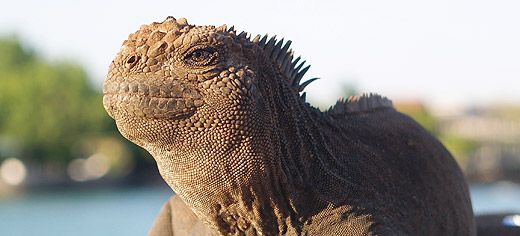
Image: Marine Iguana by Penelope Curtis
Further information from:
Victoria Picknell, press office, Zoological Society of London tel 020 7449 6361, email victoria.picknell@zsl.org
Please contact the University of Leeds Press Office on +44 (0)113 343 4031 or email pressoffice@leeds.ac.uk
Notes to editors:
West Nile Virus Vector Competency of Culex quinquefasciatus Mosquitoes in the Galápagos Islands (Am J Trop Med Hyg 2011 85:426-433; doi:10.4269/ajtmh.2011.10-0739). A copy of the paper is available on request.
- This study was supported by a Natural Environment Research Council (NERC) Doctoral Training Grant to the Faculty of Biological Sciences, University of Leeds, with additional support from the Darwin Initiative grant EIDPO15.
- Founded in 1826, the Zoological Society of London (ZSL) is an international scientific, conservation and educational charity: our key role is the conservation of animals and their habitats. The Society runs ZSL London Zoo and ZSL Whipsnade Zoo, carries out scientific research in the Institute of Zoology and is actively involved in field conservation in other countries worldwide. For further information please visit http://www.zsl.org/
-
The Faculty of Biological Sciences at the University of Leeds is one of the largest in the UK, with over 150 academic staff and over 400 postdoctoral fellows and postgraduate students. The Faculty is ranked 4th in the UK (Nature Journal, 457 (2009) doi:10.1038/457013a) based on results of the 2008 Research Assessment Exercise (RAE). The RAE feedback noted that "virtually all outputs were assessed as being recognized internationally, with many (60%) being internationally excellent or world-leading" in quality.
The Faculty's research grant portfolio totals some £60M and funders include charities, research councils, the European Union and industry. http://www.fbs.leeds.ac.uk/
- The Natural Environment Research Council (NERC) funds world-class science, in universities and its own research centres, that increases knowledge and understanding of the natural world. It is tackling major environmental issues such as climate change, biodiversity and natural hazards. NERC receives around £400m a year from the government's science budget, which is used to provide independent research and training in the environmental sciences. http://www.nerc.ac.uk/
- The Galapagos Islands and their flora and fauna are famous for the role they played in inspiring Charles Darwin's thinking on the theory of evolution by natural selection. Discovered in 1535 by the 4th Bishop of Panama after his ship drifted off course, the archipelago consists of 13 main islands, 6 smaller islands, and 107 islets. Administered by Ecuador, the islands straddle the equator in the Pacific, 1000km from the continent. Around 90% of the land area of the archipelago is national park, and a zone extending 40km offshore from the islands is a marine reserve, forming one of the largest marine protected areas in the world. The islands are a UNESCO World Heritage site, but were placed on the 'Sites in Danger' list in 2007, due to threats from introduced species and other factors driven by rapidly growing immigration and tourism. Since 1991 visitor numbers have increased from 41,000 to greater than 160,000 annually, while the local population exceeds 40,000, with a growth rate of around 4% per year. Growth in the tourist economy has averaged 14% per year since 1992, which means that if Galapagos were a country, it would have one of the fast growing gross domestic products in the world. In 2007 the Galapagos tourist economy generated more than US$418 million. Compared to other isolated archipelagos, the Galapagos Islands are still relatively pristine with 95% of its original biodiversity intact. Although 4 sub-species of Galapagos tortoise, and 3 endemic rodent species have been lost since the arrival of humans, the number of vertebrate extinctions to date are still small. However, a large proportion of the remaining species of all kinds are threatened due to habitat loss, invasive species or over-exploitation. Galapagos is most famous for its endemic reptiles (11 sub-species of giant tortoise; 3 species of land iguana and the world's only species of sea going lizard, the marine iguana; 7 species of lava lizard; 5 endemic and 1 native species of gecko), terrestrial birds (22 endemic species), and large sea bird colonies (including the only penguins and albatrosses found on the equator, and the world's only flightless cormorant species). However, it also has many lesser known species including 3 species of endemic rice rat, 57 endemic species of land snail, and a very large number of insect species, which grows each year as more are discovered. In addition there are 560 native plant species (180 endemic), but this is now exceeded by the number of introduced plant species which stands at more than 700.