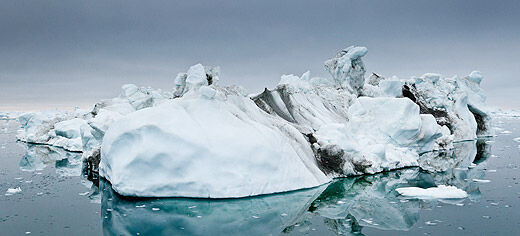
An international team of satellite experts has produced the most accurate assessment of ice losses from Antarctica and Greenland to date, ending 20 years of uncertainty.
In a landmark study, published on 30 November in the journal Science, the researchers show that melting of the Antarctic and Greenland ice sheets has contributed 11.1 millimetres to global sea levels since 1992. This amounts to one fifth of all sea level rise over the survey period.
About two thirds of the ice loss was from Greenland, and the remainder was from Antarctica.
Although the ice sheet losses fall within the range reported by the IPCC in 2007, the spread of the IPCC estimate was so broad that it was not clear whether Antarctica was growing or shrinking. The new estimates are a vast improvement (more than twice as accurate) thanks to the inclusion of more satellite data, and confirm that both Antarctica and Greenland are losing ice.
The study also shows that the combined rate of ice sheet melting has increased over time and, altogether, Greenland and Antarctica are now losing more than three times as much ice (equivalent to 0.95 mm of sea level rise per year) as they were in the 1990s (equivalent to 0.27 mm of sea level rise per year).
The Ice Sheet Mass Balance Inter-comparison Exercise (IMBIE) is a collaboration between 47 researchers from 26 laboratories, and was supported by the European Space Agency (ESA) and the National Aeronautics and Space Administration (NASA).
Led by Professor Andrew Shepherd at the University of Leeds and Dr Erik Ivins at NASA’s Jet Propulsion Laboratory, the study combines observations from 10 different satellite missions to develop the first consistent measurement of polar ice sheet changes.
The researchers were able to reconcile the differences between dozens of earlier ice sheet studies through careful use of matching time periods and survey areas, and by combining measurements collected by different types of satellites.
Professor Shepherd, who coordinated the study, said: "The success of this venture is due to the cooperation of the international scientific community, and due to the provision of precise satellite sensors by our space agencies. Without these efforts, we would not be in a position to tell people with confidence how the Earth's ice sheets have changed, and to end the uncertainty that has existed for many years."
The study also found differences in the pace of change at each pole.
Dr Ivins, who also coordinated the project, said: "The rate of ice loss from Greenland has increased almost five-fold since the mid-1990s. In contrast, while the regional changes in Antarctic ice over time are sometimes quite striking, the overall balance has remained fairly constant - at least within the certainty of the satellite measurements we have to hand."
Commenting on the findings, Professor Richard Alley, a climate scientist at Penn State University who was not involved in the study, said: "This project is a spectacular achievement. The data will support essential testing of predictive models, and will lead to a better understanding of how sea-level change may depend on the human decisions that influence global temperatures."
Image credit: Ian Joughin
Further information:
To request an interview with Prof Andrew Shepherd, School of Earth & Environment, University of Leeds, please contact Press Office, University of Leeds Communications Office, phone +44 (0)113 343 4031 or email pressoffice@leeds.ac.uk
‘A reconciled estimate of ice sheet mass balance’ by Prof Shepherd et al is published in Science on 30 November 2012, DOI: 10.1126/science.1228102. For a copy of the paper please visit the website http://www.eurekalert.org/jrnls/sci/ (access granted to journalists registered with Science) or contact the Science press team, phone +1 202-326-6440 or email scipak@aaas.org