
Many colorectal cancer survivors struggle to cope with daily life
Around 7,000 colorectal cancer survivors in the UK struggle to cope with daily life years after their diagnosis, according to new analysis led by University of Leeds researchers.
Around 7,000 colorectal cancer survivors in the UK struggle to cope with daily life years after their diagnosis, according to new analysis led by University of Leeds researchers.

A new study may have resolved a fundamental question concerning the development of Earth as a planet on which animals could flourish: what came first, increasing levels of oxygen or complex animals?

A new £3.4 million programme will develop new tools to understand which interactions between proteins in the human body are relevant to disease.

Scientists have developed an innovative way of using one of the biggest problems facing health services—antibiotic resistance—to develop drugs to combat some of the most intractable diseases.
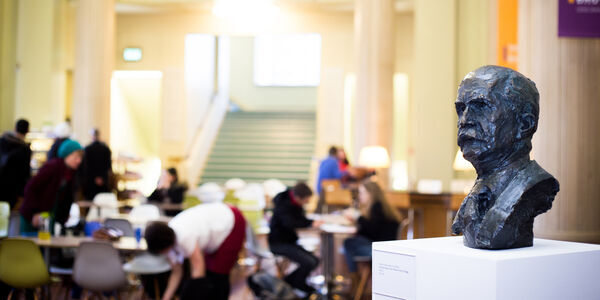
The work of the University of Leeds professor who developed one of the most influential scientific techniques of the 20th Century has been commemorated 100 years after he received the Nobel Prize.

New research into how a plant virus assembles could lay the groundwork for future use to carry drugs into the human body.
Scientists and world leaders are convening in Paris to tackle climate change, and the University of Leeds is well represented at the talks, offering a wealth of expertise in climate change science.

A new theatre partnership between the University of Leeds and West Yorkshire Playhouse is putting learning centre stage.
The University of Leeds has been named ‘Entrepreneurial University of the Year’ at the Times Higher Education Awards.

The University of Leeds has been ranked third in the UK for the employability of its graduates.