Bragg Centre for Materials Research
Driving materials innovation
The Bragg Centre for Materials Research connects materials experts to collaborate on research and innovation that benefits society, offering world-class facilities, expertise, funding and development opportunities for academia and industry.
Materials science touches every aspect of modern life. By understanding the atomic structure of materials and how it affects their properties, our interdisciplinary community is helping the UK:
- rise to the net zero challenge
- meet the population’s healthcare needs
- strengthen its infrastructure, the built environment and transport systems
- develop the high-performance connectivity and computing
- enhance the functionality, durability and sustainability of a range of products
We are a founding partner of the Henry Royce Institute, the UK’s national institute for advanced materials research and innovation.
Our work and community
-
Research areas
Explore our key research areas, spanning energy, healthcare, structural innovations, functional surfaces, electronics and sustainable consumer materials.
-
Experimental facilities
Learn more about our facilities, designed to support comprehensive materials development and discovery.
-
The Henry Royce Institute
Understand how we contribute to the Henry Royce Institute through world-leading materials research.
-
Management and governance
Find out how our external advisors and internal management team help drive our vision and activities.
Our impact stories
Find out how our community is exploring the science of materials to drive innovation, collaboration and real-world impact across industries and disciplines.
-
Combining machine learning and linear rheology to characterise recycled plastic
Researchers have created neural networks that can quickly analyse recycled plastics using linear rheology, offering a faster and cleaner alternative to traditional testing methods.
-
Sharing expertise to aid Ukraine's recovery
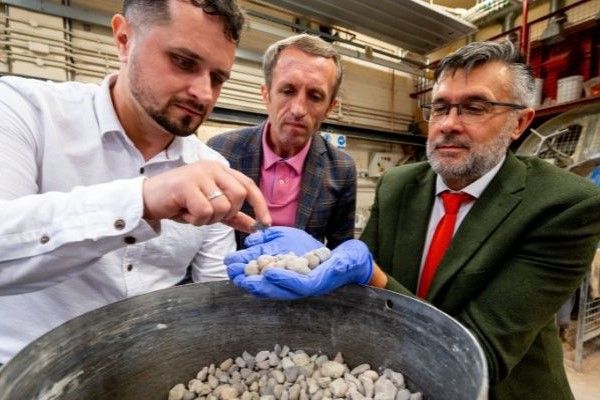
Ukrainian engineers joined Leeds academics to progress a project transforming rubble from the war into low-carbon construction materials.
-
Revolutionising advanced ceramics with hybrid 3D printing
Researchers have developed a new hybrid additive manufacturing process for advanced ceramics, enabling high-performance parts to be produced more quickly, reliably and at lower cost than traditional methods.